The Story
The story of Ekalavya remains one of the most discussed and debated episodes in the Mahābhārata. In contemporary discourse, it is often presented as an illustration of social exclusion or structural injustice in ancient India. Yet the epic itself narrates the episode with remarkable brevity and without overt moral commentary. 1
To understand this story properly, one must examine not only Ekalavya’s devotion and sacrifice, but also Droṇa’s obligations, vows, political position, and the ethical framework of his time. When placed within its original context, the episode appears not as a simple tale of oppression, but as a complex moral dilemma shaped by duty, loyalty, and competing responsibilities.
Droṇa, the son of the great sage Bharadvāja, was trained in sacred lore and martial sciences in his youth. Alongside him studied Drupada, the future king of Pāñcāla, in the āśrama of Agniveśa. In those early years, distinctions of wealth and royalty were set aside. The hermitage provided equal discipline to all students, and friendship flourished between Droṇa and Drupada. In youthful enthusiasm, Drupada once made a solemn promise:
अभिषेक्ष्यति मां राज्ये स पाञ्चालो यदा तदा ।
त्वद्भोग्यं भविता राज्यं सखे सत्यं ब्रवीमि ते ॥ 2
(Ādi Parva 130.46)
(“When I am crowned king of Pāñcāla, my kingdom shall be at your disposal. O friend, I speak the truth.”)
Time, however, alters relationships. After completing his education, Droṇa married Kṛpī, sister of Kṛpācārya, and was blessed with a son, Aśvatthāmā. Despite his mastery in Dhanurveda, Droṇa lived in severe poverty. A well-known incident describes his anguish when he could not provide milk for his young son. Out of desperation, he approached Drupada, now firmly established as king. The king rejected him coldly, asserting that friendship can exist only between equals. Humiliated and wounded in spirit, Droṇa departed, carrying within him a quiet resolve.
His destiny changed in Hastināpura. When the Kaurava and Pāṇḍava princes lost their ball in a deep well, a seemingly poor brāhmaṇa retrieved it by skilfully shooting arrows in succession to form a chain. That brāhmaṇa was Droṇa. Recognizing his extraordinary skill, Bhīṣma invited him to become the royal preceptor of the Kuru princes. Thus, Droṇa entered royal service, bound by duty to train the princes into unmatched warriors.
Among his students, Arjuna soon distinguished himself by discipline, concentration, and unwavering devotion. On one occasion, when asked whether they would fulfil his wishes after completing their education, only Arjuna pledged complete loyalty. Moved by his sincerity, Droṇa declared:
प्रयतिष्ये तथा कर्तुं यथा नान्यो धनुर्धरः ।
त्वत्समो भविता लोके सत्यमेतद्ब्रवीमि ते ॥ 3
(Ādi Parva 131.27)
“I shall strive in such a way that no archer in the world shall equal you. This I promise in truth.”
This vow, uttered with conviction, would later place Droṇa in a profound ethical dilemma.
As Droṇa’s reputation spread, many aspirants approached him. Among them came Ekalavya, the son of Hiraṇyadhanus, a chief of the Niṣādas, forest-dwelling hunters. He sought instruction in archery. Droṇa declined to accept him.
The Mahābhārata records:
न स तं प्रतिजग्राह नैषादिरिति चिन्तयन् ।
शिष्यं धनुषि धर्मज्ञस्तेषामेवान्ववेक्षया ॥ 4
(Ādi Parva 131.32)
“He did not accept him as a disciple, thinking, ‘He is a Niṣāda,’ and being mindful of his duty toward those (princes).”
The epic does not elaborate on motive or moral evaluation; it merely records the fact.
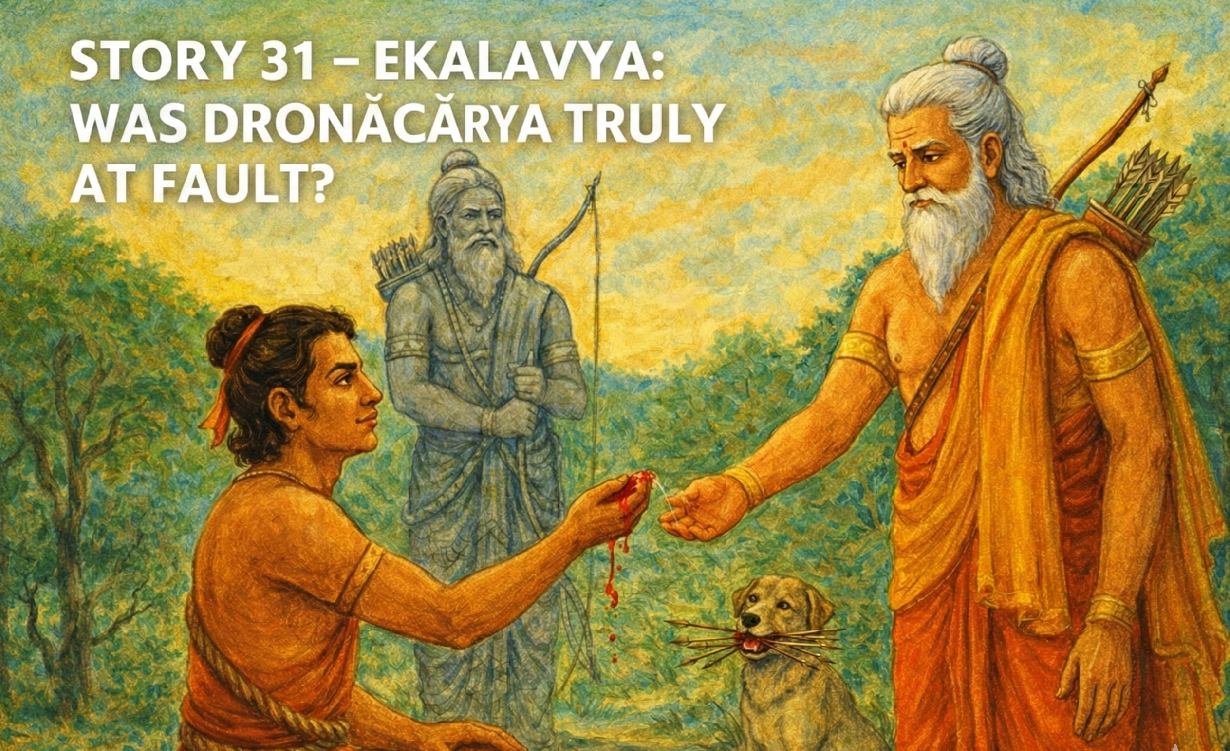
Ekalavya, however, was not discouraged. Returning to the forest, he fashioned a clay image of Droṇa, installed it with reverence, and practiced tirelessly before it. Through extraordinary dedication, discipline, and faith, he attained remarkable mastery. His skill became evident when he silenced a barking dog by filling its mouth with seven arrows without causing fatal harm. The feat astonished the Pāṇḍavas, who sought out the archer. When asked who his teacher was, Ekalavya replied that he was a disciple of Droṇa.
Arjuna, deeply concerned, approached his guru. He reminded Droṇa of his promise that no archer would surpass him. The situation confronted Droṇa with a tension between personal vow, royal obligation, and the unexpected consequence of Ekalavya’s devotion.
Droṇa visited Ekalavya and addressed him:
यदि शिष्योऽसि मे वीर वेतनं दीयतां मम ।[i] 5
(Ādi Parva 131.54)
“If you are indeed my disciple, O hero, give me my fee.”
Ekalavya joyfully agreed, considering himself blessed to serve his guru. Droṇa then asked for his right thumb. Without hesitation, Ekalavya severed it and placed it at Droṇa’s feet.
The moment is both powerful and unsettling. It evokes admiration for Ekalavya’s devotion and discomfort at the severity of the demand. Yet the episode must be understood in light of several overlapping realities.
Understanding the Story
The story of Ekalavya evokes subtle feelings of morality and a casual reader of Maha Bharata or a casual viewer of films comes to the conclusion that Ekalavya is deceived by Drona; and that the lower castes were oppressed by the higher castes.
The arguments are as follows
a. Drona refused to accept Ekalavya as his disciple and refused to teach him archery since he was a NISHADA (a hunter by caste).
b. Drona never taught him anything and yet he asked Guru Dakshina which is morally incorrect.
c. Drona incapacitated him by demanding his right thumb.
The arguments appear to be formidable but the reader has not properly understood Drona’s limitations.
The arguments in defence of Drona are as follows
a. Drona refused to take Ekalavya as his disciple since a hunter need not become dexterous in the usage of Sastras and Astras. The knowledge of Dhanurveda is required only for the princes who protect the kingdom and for Brahmins who teach it to others.
b. Drona never taught anything to Ekalavya and he was not even knowing that he was his teacher till the matter was brought to him by Arjuna. Hence, he specifically asks - ‘If you regard that I am your Guru, I am entitled Guru Dakshina’. Ekalavya could have told that Drona was not his Guru. Since he humbly accepted that he learnt everything from Drona and that he was his Guru, Drona sought Guru Dakshina.
c. Ekalavya shot seven arrows against a poor dog. He could have frightened the dog but he chose the offensive alternative. Drona must have sensed that Ekalavya was trigger friendly and he cannot control his emotions. Great Astras should be taught only to people with equanimity of mind and people with composed mental nature. The Mahābhārata consistently teaches that mastery of weapons must be accompanied by inner discipline. So, he sought his right thumb and incapacitated him. We cannot give key to nuclear war heads to foolish people. In similar way the knowledge of archery should not rest with trigger friendly people.
d. What is the moral right Drona possessed to incapacitate Ekalavya? Yes, Ekalavya is misusing the name of Drona by claiming that he was his Guru. It is like a quack claiming that he was an alumnus of a reputed University. If his actions in the practical front damage the interest of any human or the society, the society blames him and also the University. The University has the right to punish him for the deceiving act. Drona did the same thing.
e. Further, Drona was an official in the court of Hastninapura and his basic duty was to make Kauravas and Pandavas unbeatable warriors. Can he afford to go against his vritti (official) dharma by keeping silent when a rival warrior crops up on the other side of the fence? We all know that in later part of his life Ekalavya joined the forces of Jarasandha and attacked Krishna and his Dwaraka.
f. Drona knew very well that his beloved disciple Arjuna alone had the strength to defeat Drupada and his armies. His very purpose of joining the court of Hastinapur was to avenge his insult. Can he forget his basic purpose (svadharma) by disowning Pandavas, especially Arjuna?
g. Drona had promised Arjuna that he would be the greatest archer among his shishyas. Can Drona afford to disown his promise to Arjuna and become untruthful? If Ekalavya did not claim Drona as his Guru, Drona would not have any problem.
h. In this story we find Drona imparting education to the clans of Vrishtis, Andhakas and Sutas including Karna (all are either BCs/ OBCs under current nomenclature). Veda Vyasa never mentioned that the refusal to accept Ekalvya (a hunter caste) was on the ground of his lower caste. He just mentioned that Drona did not accept him as disciple since he was a hunter (nishada). Can it be interpreted as suppression of lower caste people by higher caste people in the times of Maha Bharata?
i. Drona, being an official of Hastinapur, had to teach the princes. He was not obliged to accept anybody and everybody. He has the personal liberty to say ‘no’ to anyone.
j. Finally, Drona was the very incarnation of Brihaspathi, the Guru of Gods. Ekalavya was the incarnation from a Rakshasa Gana. Drona must have an intuition of this knowledge, and he had refused to accept him as his disciple. One thing to be understood is that Drona was such dispassionate person that he even taught Drishtadyumna in the later part of his life even though he knew that Drushtadyumna had a boon and he would kill him (Drona) in warfare.
What is undeniable is Ekalavya’s greatness. His devotion was absolute. His perseverance transformed rejection into achievement. His sacrifice, whether viewed as tragic or heroic, secured his place in epic memory. He stands as a symbol of relentless self-effort and unwavering faith.
The Mahābhārata does not present this story with explicit judgment. It presents a teacher bound by vow and duty, a disciple bound by devotion, and a resolution shaped by the political and moral fabric of its time. Like many episodes in the epic, it resists simplistic categorization.
The enduring question remains: should we interpret this narrative as social injustice, as tragic dharma-conflict, or as both? Can moral decisions made within an ancient framework of duty be evaluated solely by modern ethical standards? The Mahābhārata invites reflection rather than condemnation, urging readers to confront the complexity of human choice where every path carries consequence.
Ekalavya’s story continues to provoke thought not because it offers easy answers, but because it forces us to examine how devotion, duty, power, and promise intersect in the human condition.
Questions
- Do you feel that the story symbolizes the oppression of lower caste people by higher caste people?
- Morals change from time to time and generation to generation. Can we judge an event which was morally valid some five thousand years from the current day standards of morality?
This story is taken from Adi Parva of Maha Bharata written by sage Veda Vyasa. ↩︎
abhiṣekṣyati māṃ rājye sa pāñcālo yadā tadā ।
tvadbhogyaṃ bhavitā rājyaṃ sakhe satyaṃ bravīmi te ॥
(Ādi Parva 130.46) ↩︎prayatiṣye tathā kartuṁ yathā nānyo dhanurdharaḥ |
tvatsamo bhavitā loke satyaṁ etad bravīmi te || ↩︎na sa taṃ pratijagrāha naiṣādiriti cintayan ।
śiṣyaṃ dhanuṣi dharmajñasteṣāmevānvavekṣayā ॥
(Ādi Parva 131.32) ↩︎yadi śiṣyo’si me vīra vetanaṃ dīyatāṃ mama ।
(Ādi Parva 131.54) ↩︎