Background of the Story
Drona was firmly established at Hastinapur as the Guru to Kauravas and Pandavas. Once they learnt the art of warfare, it was the time to bid adieu to students. It was also the time to accept Guru daksina from the students. He had strong enmity against Drupada, the king of Pāñcāla. Janamejaya wanted to know the reason for their enmity; and Vysampayana began narrating the story of Drupada and Drona. 1
The Story
Long before crowns and enmities defined their lives, Droṇa and Drupada lived as students under the same roof, in the same forest hermitage, as disciples of the same guru. Their primary guru was a Maharshi by name Bharadvāja, who was the father of Drona. They received foundational education in Veda, śāstra, and archery from Bharadvāja.
Agniveśa, the disciple of Bharadvāja, transmitted the knowledge of Agneyāstra to Droṇa.
Drupada was the son of Pṛṣata, king of Pāñcāla, raised to inherit a throne. Droṇa was the son of Bharadvāja, born of sacred lineage but without material wealth. In the hermitage, these distinctions dissolved. Outside it, they would return with vengeance.
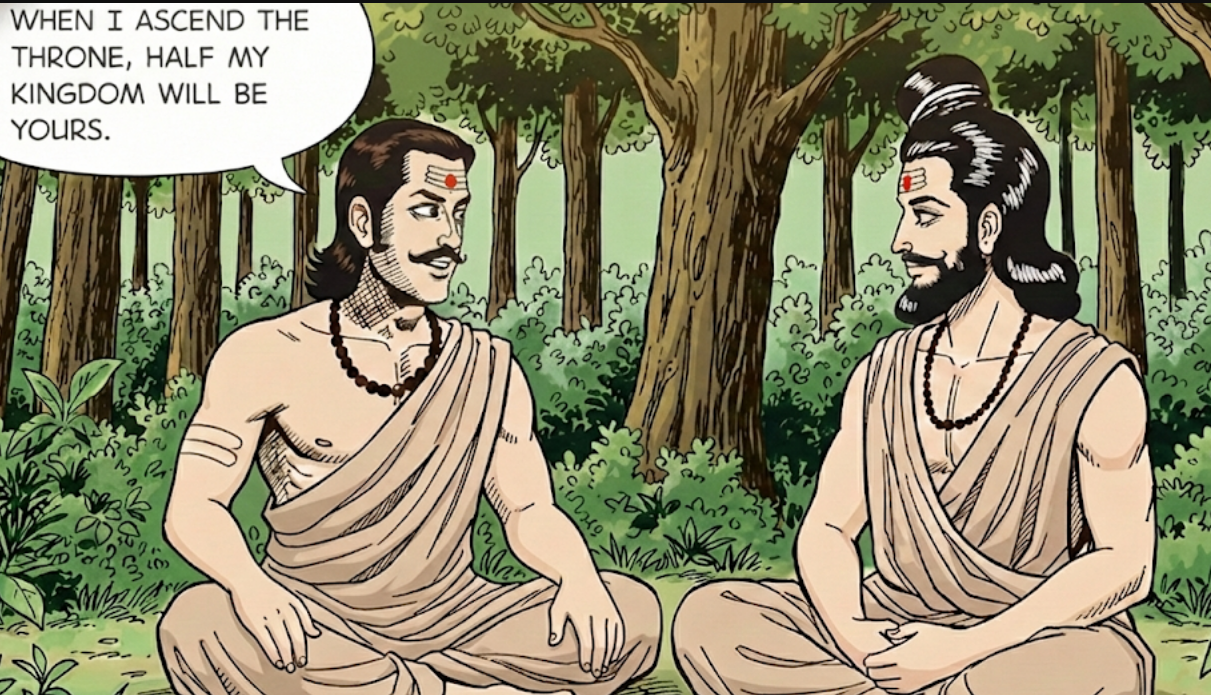
In those early years, friendship flourished naturally. The two studied archery side by side, competed in learning, and shared food and hardships. It was in this innocence that Drupada once spoke words which destiny would later weaponize:
“When I ascend the throne of Pāñcāla, half my kingdom shall be yours.”
Droṇa accepted this not as a political promise, but as the bond of friendship sealed by shared austerity.
Droṇa’s Hunger for Knowledge and Paraśurāma’s Gift
After completing his foundational education, Droṇa felt an unrelenting thirst for higher knowledge - especially of divine weapons (divyāstras). He understood that true mastery in warfare required not merely physical skill but mantra-vidyā, discipline, and the favour of a great teacher.
For this, Droṇa approached Paraśurāma, the eternal warrior-ascetic who had annihilated the corrupt kṣatriyas twenty-one times and was revered as the supreme authority on weapons. Paraśurāma taught only those who lived by austerity and humility.
Droṇa presented himself truthfully as a brāhmaṇa devoted to learning.
Pleased by his discipline, Paraśurāma instructed Droṇa in celestial arms - including the Brahmāstra, whose knowledge alone placed Droṇa among the most powerful warriors/ teachers of the age.
Droṇa did not misuse this knowledge. He carried it like a coiled serpent - silent, controlled, and waiting.
Poverty, Insult, and the Death of Friendship
Years passed. Drupada returned to Pāñcāla, defeated rival kings, and ascended a magnificent throne. Droṇa married Krupi, sister of Krupacharya, and soon faced grinding poverty. When his son Aśvatthāman cried for milk, Droṇa mixed flour with water and offered it as substitute and sustenance. Poverty drove him to Pāñcāla.
Droṇa approached Drupada not as a beggar but as a former friend, reminding him of their shared past. He wanted to have a cow from Drupada.
But kingship had erased memory.
Surrounded by courtiers, Drupada laughed. His reply was not merely dismissive - it was cruel.
“Friendship exists only between equals. How can a king befriend one who owns nothing?”
It was a great moral rupture. Droṇa said nothing. He got insulted. He bowed and left the court, humiliation burning silently within him. From that day, friendship transformed into resolve to defeat.
A Ball, a Well, and the Revelation of Genius
Meanwhile, in Hastināpura, the princes of the Kuru dynasty - Kauravas and Pāṇḍavas - were growing restless. Though trained in basic arms, they lacked a master worthy of their destiny.
One day, while playing, their ball fell into a deep well. Unable to retrieve it, they saw a poor brāhmaṇa nearby - Droṇa - who calmly plucked blades of grass, powered them with mantra, and pierced the ball, drawing it out.
Astonished, the princes requested a demonstration. Droṇa threw a ring into the well and plucked it out with a chain of arrows.
Arjuna watched in silent awe. He knew instantly: this was the teacher he sought.
The princes returned and reported the incident to Bhīṣma, who immediately recognized Droṇa’s worth and invited him to be the Guru of Kauravas and Pāṇḍavas.
Droṇa as Guru and the Making of Warriors
Installed as royal preceptor, Droṇa began rigorous training. The princes lived once again as students, rising before dawn, practicing relentlessly, and learning both warfare and restraint.
Droṇa devised numerous tests - not to display cruelty, but to measure the presence of mind, courage, loyalty, and obedience of the princes.
The Crocodile Test
Once, while bathing in the Gaṅgā, Droṇa cried out that a crocodile had seized him. He could have saved himself, but he wanted to test his students. While all Kauravas were running helter-skelter to fetch weapons, Arjuna picked an arrow, aimed it and tore the beast apart, and saved his guru. This test indicates Arjuna’s alertness, his instant obedience and his absence of doubt.
The Night Practice
Droṇa secretly observed Arjuna practicing even in darkness. When confronted, Arjuna replied:
“If the target exists in daylight, it exists at night also.”
“If eating can happen in the absence of a lamp, archery can also happen at night”
Droṇa smiled - his decision was sealed.
Arjuna, the Eye of the Bird, and Exclusive Teaching
The famous bird-eye test followed. Only Arjuna saw the target. Others looked the target and entire surroundings. From that moment, Droṇa resolved:
“Arjuna shall become the greatest archer of this age.”
He taught Arjuna techniques not taught to others - not even to Aśvatthāman. This favouritism, though justified by merit, sowed jealousy among the Kauravas.
The Guru-Dakṣiṇā and Drupada’s Fall
When training ended, the princes approached Drona with all reverence and said, “What shall we give you in return for this knowledge?”
Initially Drona refused to accept, but upon persistence, he sought a Guru Dakshina - the capture of Drupada and bring him to his place.
The Kauravas failed. The Pāṇḍavas succeeded. Bhima & Arjuna pounced upon the army of Drupada and defeated the entire army. Bhima caught hold of Drupada and when he tried to inflict a powerful punch, he was prevented by Arjuna. Arjuna famously said, “My Dear brother! Drupada is not our enemy. We are fighting with him to pay our Guru Dakshina’. Drupada was pleased to hear the sagacious words of Arjuna, he wanted to have Arjuna as his son-in-law.
Drupada was bound and brought before Droṇa. Then came words colder than weapons:
“Now we are equals. I have conqured your Pāñcāla. But I allow you to rule it” - Droṇa spared his life - but not his pride.
The Fire That Gave Birth to Destiny
Humiliated, Drupada turned inward. He performed a great yajña under two prominent purohits - Yāja and Upayāja, seeking vengeance. He wanted a son capable enough to kill Drona and a daughter worthy enough to marry Arjuna. Drupada’s anger was against Drona but not upon Arjuna who cautioned Bhima not to kill him. Arjuna’s famous words that Drupada was not his enemy, and the war with him was for keeping up the word given to Drona.
From the Yagna fire arose Dhṛiṣṭadyumna, destined to kill Droṇa.
From the same fire also arose Draupadī, whose birth was accompanied by a celestial proclamation that she would become responsible to end the age of adharma.
Conclusion: When Learning Becomes Fate
Thus, the ego gave rise to rupture of friendship, and friendship to enmity.
Droṇa achieved revenge - but created the instrument of his own death. The seeds of Kurukṣetra were now irreversibly sown.
Understanding the Story
The story is simple, yet powerful. The lack of sagacity and the ego led a person to definite down fall. The humiliation inflicted against Drona by Drupada resulted in the breakdown of friendship. In similar circumstance, Krishna displayed sagacity and honoured his good old friend Kuchela. Drona was poor by wealth; but rich in archery and warfare. Failure to recognise the talent led to permanent breakdown of Friendship. In the war of Kuruksetra. Drona finally defeated and killed Drupada.
Points to ponder
- Do you think that misunderstandings and ego-centralism among human race are the basic cause for wars?
- Do you agree with the view that passion and persistence result in great achievements in the real life?
This story is from Adi Parva of Mahabharath written by sage Vedavyasa ↩︎