Background of the Story
After the demise of King Pāṇḍu and Mādrī’s sahagamanam, the Maharshis brought Kunti and the Pāṇḍavas to Hastinapur, and Dhṛtarāṣṭra received them with courtesy. All one hundred and five brothers (Kauravas and Pandavas) started living together. 1
The Story
After the arrival of the Pāṇḍavas into Hastināpura, a quiet transformation began to settle over the Kuru kingdom. The young princes - sons of Pāṇḍu and Dhṛtarāṣṭra - played together, studied together, and grew together within the sheltering walls of the great city. Yet beneath that outward calm, unseen currents of jealousy and insecurity were slowly rising. This episode narrates the early seeds of discord - the moment when Duryodhana, driven by envy and fear, attempted to end Bhīmasena’s life.
Vedavyāsa Foretells the Shadowed Future
Sometime after the arrival of Kuntī and the young Pāṇḍavas from the forest, Bhagavān Vedavyāsa came to Hastināpura to meet Satyavatī. He had sensed the currents of fate growing turbulent.
In a private chamber of the palace, the great ṛiṣhi addressed his mother in a grave tone. “O Devi Satyavatī,” he said, “the days ahead will not be gentle to the Kuru race. A fire of jealousy and ambition will soon rise among your descendants. The harmony you dreamt for this lineage will be shaken. These children - your grandsons - are destined for conflict. Terrible sorrows wait on the road ahead.”
Satyavatī, now aged and weary from the burdens of her long life, listened in silence. She knew that Vedavyāsa never spoke without reason.
The sage continued, “In the future, people will go astray and live in adharma. They will become deceitful and wicked. The traditions and pious acts shall perish. Hence, before the onset of a diabolic society, withdraw from worldly life. Seek the peace of the forest. That is the path of serenity for you now.”
The queen mother accepted his counsel. Satyavatī, along with her daughters-in-law Ambikā and Ambālikā, left Hastināpura to spend the rest of their days in the forest hermitage of sages. There, in quiet austerity, they eventually departed from the world - passing away before the great storm of the Kuru destiny began to unfold.
Their departure symbolised the closing of an old era, and the beginning of a new and turbulent one.
The Games of Childhood and the Rise of Jealousy
The Pāṇḍavas and Kauravas were now in their growing years. They played in the palace courtyards, the gardens, and the broad open grounds of Hastināpura. Of all games, they preferred wrestling, running, climbing, and swimming - the natural fields of youthful adventure.
Bhīmasena, even as a boy, possessed extraordinary physical strength. He would uproot small trees in jest, lift heavy stones with effortless ease, and overpower any companion in wrestling bouts. In swimming, he would dive deeply, move swiftly, and resurface with a laugh that echoed across the lake. When climbing trees, he could leap between branches like a trained monkey, leaving others far behind.
Whenever the children formed teams, they placed Bhīma at the forefront. In mock battles, he played the general; in games of race, he always led; in wrestling, he remained undefeated.
What was for Bhīma a natural expression of his strength became for Duryodhana a daily torment. Every victory of Bhīma burned like slow poison in his heart. Each cheer that Bhīma received from other children deepened Duryodhana’s resentment.
He would often return to his chambers grim-faced, unwilling to speak even to Karṇa or Duḥśāsana. The seed of envy that had sprouted at Bhīma’s arrival began now to take firm root.
Duryodhana’s mind whispered:
“If Bhīma grows stronger, if he stands beside Yudhiṣṭhira, what chance have I for the throne?”
The Diabolic Plan at Pramāṇakoti
Duryodhana’s thoughts gradually darkened into a resolve. The envy of a child is momentary; the jealousy of a prince destined for power becomes dangerous. He began to plan in secrecy - plotting to remove Bhīmasena permanently.
The Gaṅgā flowed with majestic beauty outside Hastināpura, and not far from the city, there was a pleasant spot known as Pramāṇakoti. The place was secluded, surrounded by trees, and had a small lake used by the princes for swimming.
Duryodhana realised that this was the perfect setting - no watchful elders, no guards, and enough isolation for a deadly act to appear like an accident.
He invited all the princes to a picnic there. Delicious food, sweets, and drinks were prepared. Into one of the bowls of sweetened milk, he mixed a deadly poison - so potent that even a strong man would collapse in moments. This specially prepared bowl he kept aside for Bhīma.
Bhīmasena, fond of food by nature, ate heartily and drank the poisoned milk without suspicion. When the children later swam in the lake, Bhīma suddenly felt an overpowering dizziness. The poison coursed through his body, tightening around his senses like a black fog.
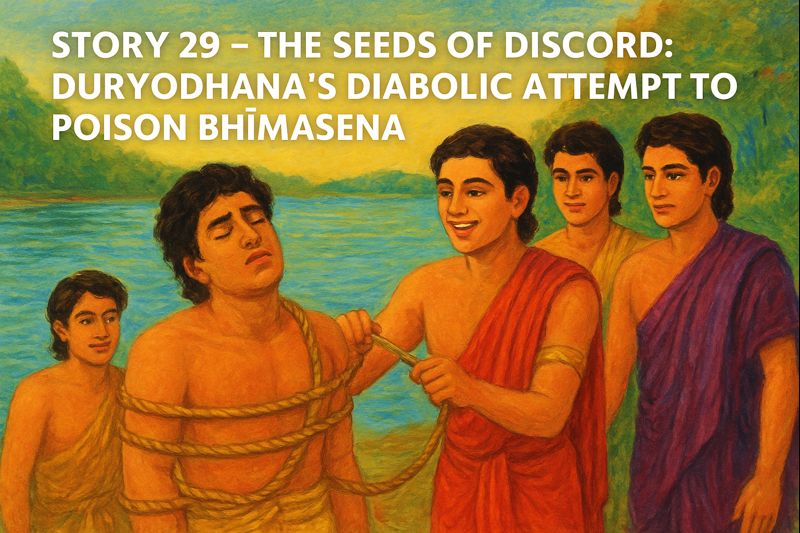
Exhausted and half-conscious, Bhīma rose up from the water and slept in a secluded spot. The other children did not observe what was happening there and they had left. With sadistic disdain, Duryodhana tied his body with ropes and threw Bhīma into the river Ganges.
He rejoiced, believing that he had finally removed his greatest threat.
Bhīma and the Serpents of the Underworld
The unconscious Bhīma sank to the lake-bed, where coils of snakes were resting in the cool waters. Disturbed, they bit him repeatedly. Yet each venomous bite neutralised the human poison inside him; the serpent venom, instead of killing him, counteracted the earlier toxin.
Soon, the Nāga venom began to act as its own antidote.
The Nāgas dragged his body through underwater passages to the subterranean world - the splendid Nāga-loka, glowing with jewel-lit chambers and glittering halls.
There, Bhīma slowly regained consciousness. His massive frame, even in childhood, astonished the Nāgas who surrounded him. Aryaka, a noble Nāga elder and grandfather of Bhīma’s mother Kuntī through her lineage, recognised the boy.
“This is Bhīmasena, son of Pāṇḍu,” Aryaka declared. “He is born for great deeds.”
The Nāga king Vāsuki, moved by affection and admiration, welcomed the young prince. Seeing Bhīma’s extraordinary strength and potential, Vāsuki offered him a divine gift. He gave Bhīma a sacred pāyasa, a milk preparation infused with Nāga power. Bhīma consumed the pāyasa.
By Vāsuki’s grace, Bhīmasena’s strength grew to that of a thousand elephants - a power that would one day shake kingdoms.
After blessing him, the Nāgas gently carried him back to the surface near the same lake from which he had been taken.
The Rage of Dharmarāja and Bhīma’s Vow of Silence
Kunti’s agony knew no bounds. She repeatedly asked the other Pandavas to search for Bhīma. By that time Vidura arrived and started consoling her.
When Bhīma finally returned to the palace, all of them were overwhelmed with relief and concern. Hearing the entire account, Dharmaraja embraced Bhīma warmly and said in a firm voice:
“Do not reveal this to anyone - not even to the elders. We must not sow discord. Time itself will reveal truth. It is enough for me to know that destiny protects you.”
Bhīma obeyed.
Meanwhile, Duryodhana secretly tried again - slipping poison into Bhīma’s food. But now, strengthened by Nāga pāyasa, the young prince remained entirely unaffected. Each failed attempt only made Duryodhana more desperate.
The seeds of hatred had now fully sprouted. Jealousy had mutated into fear.
The Birth of Kṛpa, Droṇa, and Aśvatthāmā
Around this period, Hastināpura witnessed the arrival of a few destined personalities Kṛpācārya, and Drona. The birth of kṛpācārya and Drona is interesting. There lived a sage by name Saradvad Gautama who gained mastery in Dhanurveda (archery) by extraordinary tapas. One day he happened to see a divine lady, Jānapadi and his retas fell on the grass nearby. It got detached into two parts and out of it emerged a girl child by name Krupi and a boy child Krupa.
King Śantanu of Hastinapur discovered the children on the outskirts of the forest, and he picked the children and brought them to Hastinapur. He adopted them as his own children and raised them in the palace. Saradvad Gautama was happy that his children were being raised in the palace. He reached Hastinapur and taught the entire Dhanurveda to Kṛpa. Krpa grew into a master of warfare and began to be revered as Kṛpācārya. Initially, he was the teacher for both the Kauravas and Pandavas.
Kṛpī later married Droṇa, a brilliant but impoverished Brahmin youth trained under the great Paraśurāma. Their son Aśvatthāmā was born with extraordinary prowess, marked by a gem embedded in his forehead. Droṇa started living in Hastinapur and later became the teacher for the Kauravas and Pandavas.
Thus began the formal education of both Pāṇḍavas and Kauravas - a period that would shape the destinies of the children who were now growing into warriors.
Conclusion
The attempt to poison Bhīmasena marks the first clear sign of the coming conflict - an act born from fear, jealousy, and the insecurity of a prince who feared being overshadowed. Bhīma’s descent into Nāga-loka, his blessing of a thousand-elephant strength, and Droṇa’s arrival in Hastināpura add layers of destiny to the unfolding narrative.
This episode reveals something crucial: The seeds of the Mahābhārata war were planted not in the battlefield of Kurukṣetra, but in the playgrounds of Hastināpura - inside the heart of two young princes whose paths were already diverging.
The birth of Droṇa and the vidyābhyāsa (education) of the Kauravas and Pandavas will be discussed in our next episode.
Questions
- Greed and jealousy are the root cause of enmity. Substantiate the statement from the above story.
- What is the role of parents when children develop jealousy against fellow children?
- What are the different types of poisons and how do they become antidote to one another?
- Do you think that wars across the world have their seeds in the minds of the men? Substantiate.
This story is taken from Adi Parva of Mahabharat written by Veda Vyasa. ↩︎