Background of the story
After the birth of all five sons - Yudhiṣṭhira, Bhīma, Arjuna, Nakula, and Sahadeva - the āśrama of Pāṇḍu settled into a quiet rhythm. King Pāṇḍu settled down in the forest with his two wives and five children. 1
The Story
The forest around them echoed with a serenity that seemed to cradle the young princes in its arms. Pāṇḍu considered those years a blessing: liberated from the burdens of kingship, he devoted himself fully to the upbringing of his sons. He would rise before dawn, perform his austerities, and then take the boys through the disciplines of kṣātra-dharma, teaching them steadiness of hand, absence of fear, and the uncompromising truthfulness that a ruler must cultivate. These were days of warmth, instruction, and deepening paternal affection.
When the boys were old enough for proper martial training, Pāṇḍu sought the guidance of Śuka, (not the wandering son of Vyāsa), revered as a guardian of ancient Śaryāti lore. Śuka was a Kshatriya and had the credit of performing a hundred Asvamedha yāgās and hundreds of years of tapas. He initiated the young Pāṇḍavas into the earliest disciplines of dhanurveda - control of breath, the stillness before the release of an arrow, the balance of mind and posture that precedes skill. Thus, before they acquired external accomplishments, they were shaped inwardly, and these foundations would one day support the extraordinary destinies of all five brothers.
Even as the children flourished, a quiet turmoil grew within Pāṇḍu. The curse of the ṛiṣhi Kiṇḍama had always hovered like a shadow over his life. Though he had sons through the divine mantra of Kuntī, his heart yearned for a freedom that destiny denied. The forest life, with its solitude and its beauty, heightened his sensitivity; Mādrī’s gentle presence often stirred a tenderness that filled him with both longing and fear. He wrestled inwardly, for he knew that desire was death itself. Yet human frailty is not easily conquered, and the changing seasons often pulled at his mind.
One spring morning, when the forest was fragrant with blossoming creepers and the wind hummed its intoxicating tune, Pāṇḍu went out with Mādrī into the woods. The day was bright, the earth was fresh, and the season of flowers had woven its inescapable spell. In that moment of unguarded delight, Pāṇḍu forgot the curse. He embraced Mādrī much against her will and Kindama’s curse was hovering over him with deadly effect. Within that very act, death struck him and his body fell silent, his face serene, as though he had merely surrendered to a deep, sudden sleep.
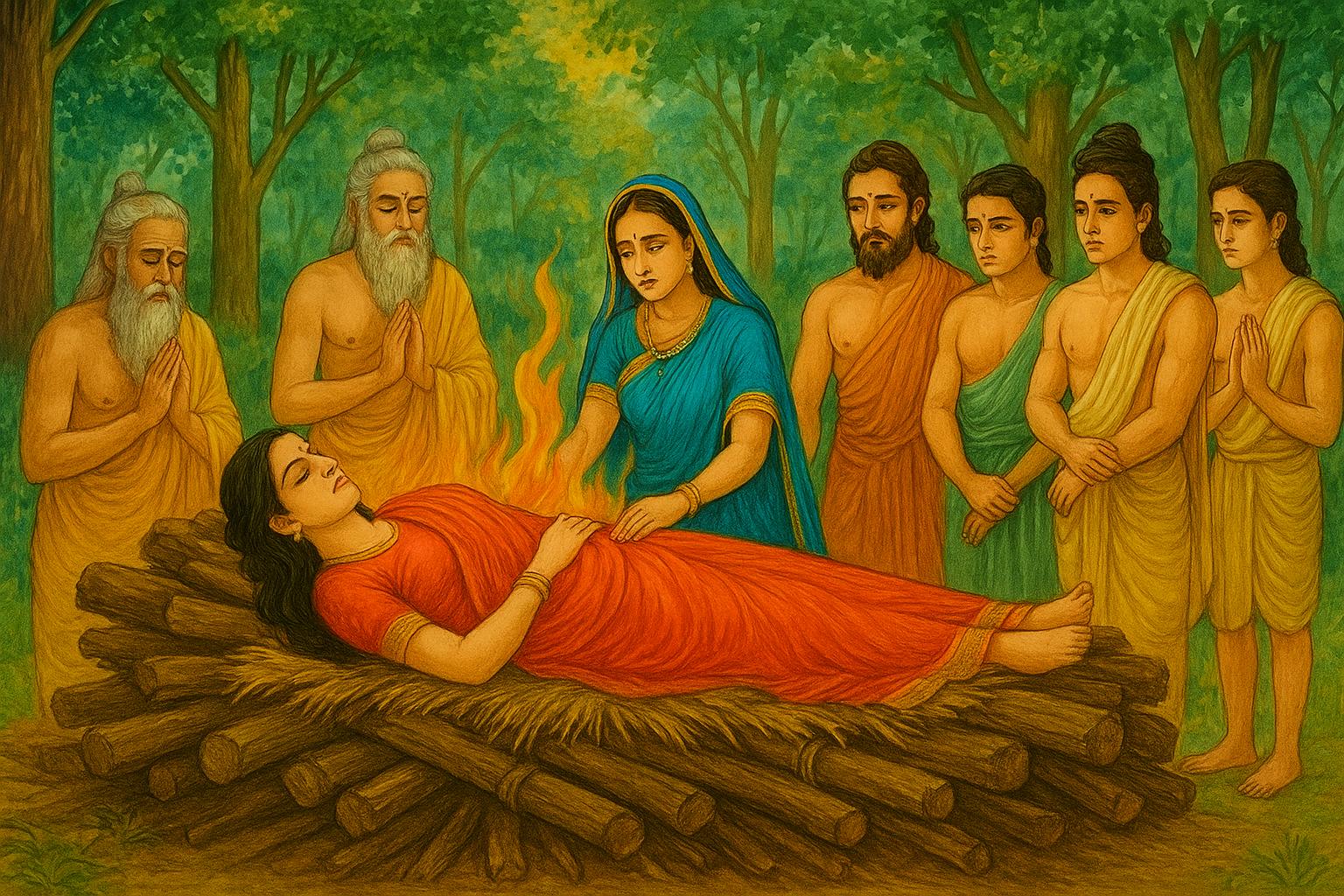
Mādrī’s anguished cry echoed through the forest. Kuntī rushed to the spot, and her heart froze at the sight of Pāṇḍu’s lifeless form resting upon Mādrī’s trembling lap. Understanding at once what had transpired, she asked, “Oh Mādrī! Is it not your responsibility to save the king? How could you allow him to meet you in the woods? Any way you are blessed – that you have given happiness to the king before his death”. Mādrī could not answer. Mādrī, overwhelmed by guilt and sorrow, declared that Pāṇḍu’s death was hers to share. She felt that his final moment belonged to her alone, and therefore she must accompany him beyond life. She believed that if she continued living, the memory of that fateful instant would consume her every day. Her heart knew no path other than sahagamanaṁ.
Kuntī, being the elder queen, volunteered to go along with king Pāṇḍu, but Mādrī did not agree for the idea. She owned the responsibility for Pāṇḍu’s death and she wanted to die.
The rishis, however, urged restraint. They reminded Kunti and Mādrī that widowhood was not an escape but a sacred responsibility, especially when children were young. They insisted that the five boys needed both mothers. The task of raising them, guiding them in dharma, and protecting them from the uncertainties of life was not light. They pointed out that the śāstras did not command sahagamanaṁ; it was a choice, not a duty. Living on with the welfare of children was as noble as any sacrifice.
They suggested both queens to live and perform the austerities of widowhood instead of performing act of sahagamanam. The widows can remain in brahmacharya vratam, control the senses, follow the rigorous dietary practices, indulge in arduous rituals like चान्द्रायणव्रतम् (Cāndrāyaṇa vrataṃ), fasting, sleeping on floor and the like so as to avoid the thought of sensual pleasures.
But Mādrī was not willing to live with a guilt and preferred death over life. She acknowledged Kuntī’s strength and experience-qualities that had carried her through years of adversity. The twins, Nakula and Sahadeva, she said, would be safe in Kuntī’s care, for the elder three brothers were already firmly attached to her. Mādrī believed she lacked the inner resilience required for long widowhood. If she lived, her mind would remain broken; if she died with Pāṇḍu, she believed she could achieve peace.
The forest-sages soon gathered, and among them came Vedavyāsa, whose presence brought solemnity to the moment. He advised Kuntī to accept the burden of motherhood without shrinking, for her destiny was intertwined with the future of her sons. To Mādrī he said that sahagamanaṁ should be embraced only if it arose from true conviction. Mādrī bowed to the sage, for her resolve was already firm.
The pyre was prepared. After bathing and wearing simple yet spotless garments, Mādrī approached Pāṇḍu’s body with serene dignity. She bowed at his feet, whispered her final words, and placed her head upon his chest. As the flames rose around them, it was not a spectacle of passion but a solemn act of surrender, narrated by the epic without sensationalism, as an individual decision born of inner clarity and personal dharma.
After the rites were completed, the ṛiṣhis conferred among themselves and decided that Kuntī and the Pāṇḍavas must be taken to Hastināpura. Yudhiṣṭhira, though barely in his mid-teens, carried himself with quiet maturity; Bhīma and Arjuna were still boys; the twins were scarcely aware of their loss. The journey was long, but the children found comfort in the presence of the sages.
When they reached Hastināpura, the ṛiṣhis approached Dhṛtarāṣṭra and informed him of Pāṇḍu’s death. They explained how Pāṇḍu was the real father of all Pāṇdavās. They urged him to accept the Pāṇḍavas with affection and responsibility. Dhṛtarāṣṭra, though troubled inwardly by his complex feelings toward his brother’s sons, nonetheless received them with formal dignity. Immediately the rishis disappeared much to the astonishment of everybody. The final obsequies of Pāṇḍu were performed with royal honours, and thus the young princes began a new chapter within the palace that would soon become the arena of affection, rivalry, ambition, and destiny.
The escapades of the hundred and five children (Kauravas & Pandavas) will be discussed in our next episode.
Points to Ponder
The law of Karma chased king Pāṇḍu. King Pāṇḍu killed an animal when it was in sensual delight (see the previous episode for details) and he had to pay his life for his act of embracing Mādrī. A popular Sanskrit subhāṣita (ethical aphorism) states the Law of Karma in the following manner.
यथा धेनु सहस्रेषु वत्सो विन्दति मातरम् ।
तथा पूर्वकृतं कर्म कर्तारमनुगच्छति ।। 2(In the midst of thousands of cows, the calf recognizes and reaches its mother. So also, a person’s deeds follow him, and he must experience its effects).
चान्द्रायणव्रतम् (Cāndrāyaṇa vrataṃ): The word is like rāmāyaṇam = rāma + āyanam (journey of Rāma. In the same way Cāndrāyaṇa means the journey of the Moon. The journey of the Moon is not uniform – ascendancy for fifteen days and descendancy for fifteen days. Following the phases of the Moon, a practitioner of Cāndrāyaṇam eats 32 mouthfuls of food on Full Moon Day (Paurnami) and goes on reducing the quantity everyday so as to become a total fasting person by New Moon Day (Amāvāsya); and again goes on increasing quantity day by day until 32 mouthfuls by Full Moon Day. This is a rigorous dietary practice being followed even by today in some traditional families. This tradition is from since immemorial and is traced to epics. The chief purpose of this practice is gain antaḥkaraṇa śuddi (purity and cleansing of the mind).
The principle of Niyoga was not unusual in ancient times; and hence the legality of the birth of five Pāṇdavās was not questioned by anybody in the court of Dhritarashtra. They were accepted with dignity.
Sati Sahagamanam: The most important aspect of this story is ‘Sati Sahagamana’. Madri’s death on the pyre of Pāṇdu Maharaj was one of the earliest incidents of the practice of Sati sahagamana frequently quoted by the British before it was abolished by the Governor General Lord Bentinck in 1829.
First let us understand the story part before understanding the historical perspectives of abolishing ‘Sati’. In the story, we witness the noble sages advising both Kunti and Mādrī to desist from the thought of dying. Ved Vyasa emphatically writes that if the both queens could not withstand the bereavement of Pāṇdu Maharaj, they could follow the strict regime of austerity and desist from sensual pleasures. But they should not die leaving the children to the evil intentions of Dhritarashtra. Then Kunti agreed to the arguments of noble sages. Why did then Mādrī die? She was feeling guilty of her misdemeanour and wanted to follow the king. We must also carefully read the curse of Kindama which ordained that the queen with whom he mates would also die along with the king. The curse cannot go wrong.
We also see that the Mādrī was not forced by anyone including Kunti for following the king (sahagamana). No one can blame that Sati was a forceful practice in Maha Bharata times. Thousands of kings and warriors perished in the battle of Maha Bharata and none of their ladies followed them. There was no practice of Sati even in Dwapara Yuga and we don’t see Dasaratha’s wives immolating themselves on the pyre of Dasaratha. All wives of Krishna did not do ‘Sahagamana’ when Krishna left his mortal breath. Mādrī’s death was a stray incident and was out of her own volition. It was not forced by anybody and she died out of her own intentions. The freedom to do a karma depends on karta and the person can do, cannot do, or can modify doing in a particular fashion.
Then why did the British blame Hindu society as a society riddled with obnoxious practices? Towards the end of eighteenth century, the British Missionaries were desperately trying to legitimize their rule in India, and they started preaching that Hindus was race with no distinct morals or ethical practices. The very existence of British, according to them, was to civilize Hindus and it was ‘White Man’s burden’. They found the practice of Sati to expose Hindu society. For understanding the supposed practice of Sati, one should read the book of Prof Meenakshi Jain, “Sati: Evangelicals, Baptist Missionaries, and the Changing Colonial Discourse”, available at Amazon India. She had done extraordinary research on all recorded incidents of ‘Sati’ and came to a conclusion that in the total history of 6000 years, the recorded incidents were only in hundreds (that too, many were during Muslim invasions) whereas the Britishers exaggerated the figures, created an impression of Hindu superstitions and wanted to save the race from ‘inglorious social institutions. The media-created narratives that we witness in the current century have their origins in the eighteenth century India ruled by the British. (For understanding history behind the abolition of Sati by Willium Bentick, please listen to the ten-minute YouTube conversation of Prof Meenakshi Jain with Rajiv Malhotra by clicking: https://www.youtube.com/watch?v=apTNtSWjsQk)
Nowhere in Smriti and Sruti literature we find any support for the system of Sati, though there are codes of conduct for widows.
Questions
- We come across many people criticising the God for their misfortunes and sufferings. Do you feel that the God is responsible for anybody’s misfortune? If not, what is responsible for their sufferings?
- Indian society was labelled as superstitious and the British claimed to save this race as part of their duty- Whiteman’s burden. How far it is true?
- Should we believe media-created narratives before jumping into conclusions? What precautions are required to understand our nation’s pride and our society?
- Do you feel that reading original scriptures can dispel many myths concocted by foreign historians?